System Settings

The system settings page is a critical component of MyClientSpot. It provides administrators with the tools they need to configure and customize the MyClientSpot to meet their specific needs.
MyClientSpot is a unique project management app that sets itself apart from other similar tools by allowing clients to log in to the app. Many of the settings on this page control exactly which information is shared with clients. Learn about how to setup client users in the users guide

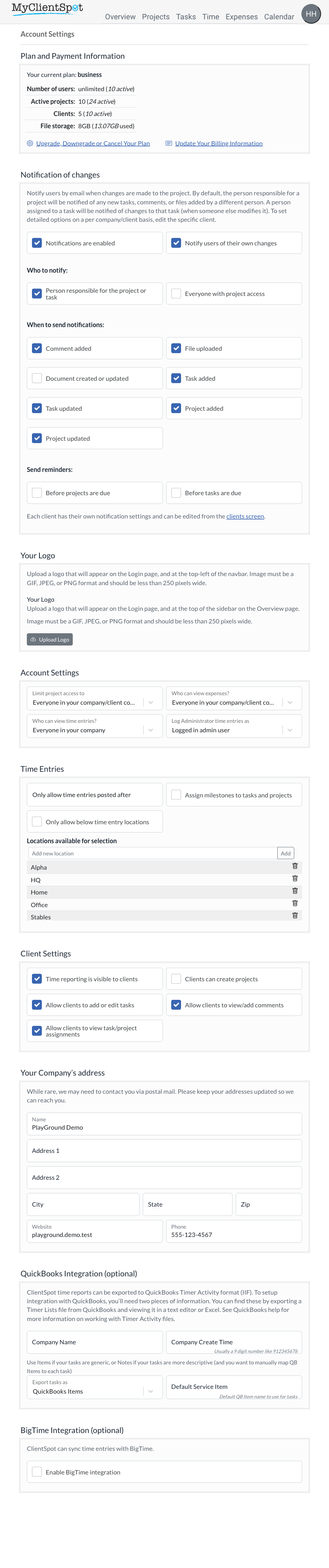
Change Plan and Billing
Notification Settings
Custom Logo
Employee access
Control time entries
By default locations are not required for time entry. However, you may set it to be so. If you do, then a location will then become a required field on time entries. Locations can be pre-defined or added on the go.
Client access
Export to QuickBooks
Custom fields
Custom fields let you record information on projects and tasks that MyClientSpot does not track by default, such as a purchase order number, a region, or a ticket ID from another system.
Projects and tasks each have up to five custom fields. To set them up:
- In the “Custom Fields” section, select the number of project fields and the number of task fields. Select “None” to turn the fields off.
- Type a label for each field. The label is the name that users see. If a label is empty, the field shows as “Custom 1”, “Custom 2”, and so on.
- Save the settings.
The fields then show on the project and task forms, as columns on the project and task listings, and in the CSV exports. Client users can see and edit custom fields on the projects and tasks that they have access to.
If you decrease the number of fields, the hidden fields keep their labels and values. When you increase the number again, they show again.
